
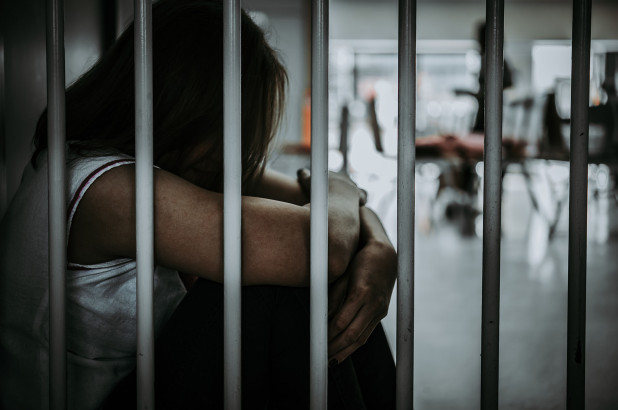
CA — . Imagine surviving unspeakable violence as a woman and, having never received justice yourself, being locked up by the state, stripped of your voice, (frequently, your clothes), your autonomy, your dignity and all decision-making power. As a woman who has survived incarceration, I can tell you that this describes my experience and the experience of most women I was incarcerated with. If you don’t believe me, look to the statistics: eighty-five percent of federally imprisoned women have experienced physical abuse and sixty-eight percent have experienced sexual abuse. The prison continues the abuse and coercive control most women prisoners know too well.
For months, I have spoken out about prisoners seeking transfers to women’s prisons from men’s prisons, because women I know, my sisters inside, are dealing with a new form of abuse: biological male prisoners, some who genuinely claim trans identity and some who don’t, peeping through their cell windows, walking around in nightgowns with their penises in full view, saying they can have sex with any women they want, engaging in harassing and grooming behaviours, sexually assaulting women in bathrooms, and on and on and on. I say some do not genuinely claim trans identity, because I’ve heard many reports from women that some of the recent transfers brag about being men and playing the system to secure their transfers to a women’s prison. In August 2018, Dr. Aaron Devor, Founder of Transgender Studies, testified before the Senate that because the policy only requires self-ID, “there are people who will take advantage of the system” to gain “access to a situation where they can be a predator.”
These issues are quite different than woman-to-woman issues that can happen in prisons as a result of conditions of confinement. They have increased in the past couple of years since Bill C-16 and CSC’s more relaxed policy for these transfers.
For decades, advocates have fought to alleviate the risks of harm to women in prison. As a result, the prisons for women today do not remotely resemble the first prison for women ever built, at least not in infrastructure. The first Federal Prison for Women (P4W) in Kingston, Ontario, was built just like the men’s, with cells and ranges.
In a three-year period from 1989 to 1991, seven women at P4W died by suicide. All but one were Indigenous. Women did not fare well in an environment built for men, go figure. Later events and inquiries, and the intervention of advocates, led to a Task Force on Federally Sentenced Women and the eventual closure of P4W. The Task Force released a report, Creating Choices, which led to the creation of six regional prisons with very different infrastructure and no barbed wire fences, at least initially. The Task Force also recommended that men not be permitted to staff the front lines in women’s prisons: “The concerns centred on correctional staff, as well as invasion of privacy of women engaged in intimate activities, such as bathing or using the toilet. It was also generally felt that in light of the very high number of women [prisoners] who were sexually abused as girls and as adults, often by males in authority, an opportunity to heal in an all female environment in the living units was important, if not essential, before being required to deal with men in such an intimate situation.”
The media’s coverage this past May of a guard sexually assaulting three women at a prison in Nova Scotia demonstrates just how real the risk of harm is when you place males in with women prisoners who are an oppressed group both because of their sex (and the historic victimization based on their sex) but also because of their captivity. But sometimes this realization is lost when it comes to transfers from men’s prisons under a policy of self-identification.
Recently, rather than advocate to alleviate harm to women, those whose mandate it is to fight for us are instead advocating for these transfers. Women’s groups and prisoners advocacy groups are failing to situate this issue in our experiences of male violence and historical inequality and oppression. For example, in an unrelated event, Women’s Legal Education and Action Fund (LEAF) denounced the Toronto Public Library for hosting a talk meant to discuss the impact to women of trans-identified males selecting to be women. EFry Mainland Nova Scotia even went as far as hosting a panel on how to make sure transfers from men’s prisons to women’s prisons happen.
This panel went forward, despite information being available about the risks. For example, a friend of mine filed a grievance in September 2019 against the Corrections Service of Canada (CSC), because they placed a biological male with a staggering history of pedophilic violence against girl children in the Structured Living Environment (SLE) with her and several other women at Grand Valley Prison (GVI). My friend has a history of childhood sexual abuse and has not been able to even begin addressing it in prison. Prior to a convicted male sex offender being placed with all of these women, the women inside were told to ignore their feelings of danger, to ignore this person’s crimes. And my friend did; she was nice to Madilyn Harks. In return, Harks tried to groom her, followed her around, told her she had a “young spirit”, “I’m horny”, and stood outside the washroom listening to her and asked her if she was on her period. No staff ever intervened in any of these incidents. In fact, when she began to deteriorate because of Harks’ predation, she was offered segregation, which we know only causes more harm. In response to her grievance, CSC cited Bill C-16 as its justification and refused her remedy: a review of its gender identity policy for its impact on women prisoners.
Before he targeted my friend in the SLE, a sexual assault report was made against him by another woman prisoner, but police did not pursue any charges. (2019 PBC Decision). We should all be critical of the fact that police did not pursue charges given what we know about police unwillingness to hold men who rape accountable. Our society already doesn’t believe women who are victims of male violence, let alone women prisoners.
Neither of these was even Harks’ first offence while in women’s “corrections”. Months earlier, Harks was revoked while on parole at a women’s halfway house in Hamilton, in September 2018, because Harks “made derogatory and sexual comments about the younger [female] resident and both the resident and staff member were uncomfortable” (2019 PBC Decision). This quote understates the predatory behaviour of Harks, which actually closely mirrored the abuse detailed in my friend’s grievance; it was the same pattern.
Had any number of people stopped to consider whether Harks’ pattern of misogynistic violence would continue when placed with women prisoners, or recognized it for what it was when it did happen, these women, my friends, would have been spared the trauma Harks caused them. The Parole Board of Canada recently released Harks to community, despite these sexual offences while incarcerated, and despite that Harks “continue[s] to be assessed as a high risk to re-offend sexually even after…gender reassignment surgery.”
No woman in prison would receive parole if she had Harks’ same behaviour or crimes. Truth be told, no women in prison have Harks’ pattern of violence, because it is male-patterned violence. Men’s and women’s pathways to prison, their criminalization, come about in very different and sexed ways. If we cannot talk about men’s violence, how can we hope to address it? Further, what happens when men’s violence is instead statistically recorded as though it were women’s, a change which is already underway?
The issue of transfers is not just about Harks, though. In a meeting on May 23, 2019 with stakeholders about transfers from men’s prisons to women’s prisons, former Deputy Commissioner for Women, Kelly Blanchette, reported that of all transfer requests from men’s prisons, 50 percent came from sex offenders who offended as men. 50 percent! This number overrepresents sex offenders who account for 20 percent of the male prison population overall. Male rapists and pedophiles just got permission from the Canadian Government to gain access to their victims. For context, only two percent of women prisoners are convicted of sexual crimes, in many cases for facilitating men’s access to victims. Kind of like the Canadian Government…
Recent court decisions aren’t protecting women, either, and have actually been reversing CSC’s transfer denials. In Boulachanis v Canada, which reconsiders the 2001 Kavanagh decision, the Federal Court ordered the transfer of Boulachanis, who is considered such high risk at a men’s supermax that armed police escorts are used for any absences from prison. The court considered the harm Boulachanis would experience by either being exposed to threats or placed in segregation, and said that “that harm overcomes the inconvenience that could result from [the] transfer to a women’s [prison].” Interestingly, the former DCW indicated at the May meeting that very few, “maybe one or two”, transfer requests from the men’s prisons cite safety concerns as a reason for requesting transfer. The Boulachanis decision, unlike Kavanagh, does not consider or weigh the possible risks of such transfers to women prisoners; rather, it considers the inconvenience to CSC of having to invest in special security measures.
CSC argues it will have to invest in new security measures (which often means importing security measures from men’s prisons), because, as I’ve established, women’s prisons are very different from men’s. Women as a group pose less risk to “public safety” (in quotes, because prisons do not keep people safe; healthy communities do). Guards in women’s prisons do not carry firearms, and women, at least those in the main compound, live in living units (LUs), rather than in cells with bars. We are locked down in the LUs, which we share with 9 to 12 women, every day from 9:15pm to 8:00am. During this time, we can’t leave the unit. A woman from Fraser Valley Prison for Women in British Columbia told me about how one trans woman there was walking around in a nightgown, penis out for the women to see. The influx of transfers from men’s prisons has led the guard’s union to begin pushing for 40mm gas launchers and guns to manage the increased security risk at women’s prisons. CSC is security-driven, so this should not come as a surprise, but it will have devastating consequences for women who’ve fought long and hard for the few sex-specific differences prisons have today, including reduced security and communal living units.

The trouble is, CSC is one of the most vocal in opposing transfers, but as Boulachanis and Harks demonstrate, CSC’s concern is their own inconvenience, not the risk to women prisoners. Almost no one, including the media, and certainly no one with much power or resources, is speaking out for women or offering a feminist analysis to move the issue forward in a thoughtful way.
Unlike in the UK, where media highlighting sexual assaults in a women’s prison resulted in swift, albeit imperfect, action, the media in Canada has stayed painfully quiet. I have approached various media outlets about the risks created for women by these transfers, and even those with initial interest tend to drop the story rather than release it, especially so-called progressive or liberal media. It’s disappointing, enraging, but not surprising in a climate where long-time women’s liberation activists are de-platformed, fired, and harassed for speaking up. Yet, it has left those of us closest to the issues, those who can’t turn away, to carry the bulk of the load.
Speaking out comes with a cost in today’s climate. I’ve been labelled transphobic for voicing concerns and trying to get a support line to the women in prison who are dealing with harassment. I’ve experienced other consequences that I would rather not discuss for fear of making matters worse for myself. Still, I can’t stand idly by as biological males, who are stronger, who often have histories of misogynistic violence, subject my sisters inside to abuse they can’t escape from. Sure, not all trans women, not all men, but can we at least begin to listen to women? Can we believe women? Can we take their concerns seriously as we move towards addressing violence against women?
Meanwhile, as resources and time are being spent on fighting in favour of these transfers, which download any risks arising from male violence in men’s prisons onto women, attention and resources are necessarily taken off other serious issues women in prison are facing. Issues like strip-searching, sexual assaults by staff, segregation, self-harm, and suicide. Last year, an Indigenous woman who grew up in jails tried to hang herself in her cell in maximum security because she couldn’t cope with the inhumanity of prison. She’s not the first and won’t be the last. The women in the cells beside her pushed their alarm buttons, alerting CSC whose staff came and cut her down. Those women saved her life.
Today, I’m sounding my alarm. Who is going to respond?
~ Heather Mason, Guest Author
Mason134211f @ Twitter
#nothingaboutuswithoutus
We will not be silenced!
Mother, Advocate, Parolee, Survivor of Fentanyl Addiction


Great article. This information needs to be heard.
Thank you so much for writing this. I too have been speaking out about incarcerated women in Canada and have been shut down by e fry and the media. Thanks for speaking the truth and getting it out there. I totally support you.
the most depressing aspect other than the very real harm done to these women prisoners is that a absolutely no one even cares about the implications of these changes on women..that’s the terrible part. We’ve had males completely redefine the meaning of women, lesbian, completely capture feminist orgs and deplatform female centered feminists (who realistically are the only legitimate feminists)
Hey there, please email me asap for I may have found a news anchor that can help.
We notified Heather Mason about your comment and passed along the email address you left.
Sharing your excellent article sister! We MUST unify and support one another because xy’s for the most part do not care about women except for what we can do for them.
Great article
Heather: what can the average canadian do to help? I’m an academic and your story has touched my heart, but I don’t have a lot of cash to throw around. I can bother my MP and things like this, but is there anything else?
Actually, right now the average Canadian should be agitating their MPs etc. about Bill C-6. It’s an outrage that trans lobbying has led to the notion that transing young girls is somehow considered by some to be a more ethical option than counselling them through adolescence intact and healthy, but here we are…
Excellent piece, Heather Mason is so amazing, isn’t she? Can someone help me understand the meaning of the word, “groom,” in this context? I’m not clear on what that means.
I’m fairly sure that the word “groom” in the context of this article means “to render a woman more receptive to listening to sexual innuendo without reporting it (as is supposed to be the case, I understand) and eventually, congress¹”. Of course, I could be much mistaken and if so, apologize unreservedly to Heather Mason.
¹As far as I’m aware, all sex acts are theoretically prohibited for those who are incarcerated
Well presented. There should already be a half dozen bestsellers thoroughly examining this issue on the shelves, flooding a market that includes all those directly and indirectly concerned. That women in general should be co-opted and bureaucratically managed into some faux solution that is hoped to just go away, that their struggles and miseries should be swept aside for some imagined greater good, speaks volumes.
I recall an interview in which the author mentioned something about the actual annual cost of her incarceration. Given that a significant majority of incarcerated women are locked up on drug-related charges, that is one hell of an expensive “solution” to addiction and bad life choices, that winds up not working for many, if not most. Which speaks volumes about a system that would rather bury a problem behind piles of cash than actually make it go away in any real sense, especially something that would actually help the women in question.
In any kind of actual ‘just’ society, it is beyond me how a fair court system does not bring this travesty to its knees, when women are placed in a situation where they must confront the sources of much of their worst traumas experienced in life. How this is ‘just’ is a fiasco, a kind of wrong-think one might expect to find in an average middle school. The system must do something (according to that infamous Bill…) and this is the best they’ve got?
Incarceration is no picnic in the first place. I think a huge part of the problem is that, like myself, the vast majority of informed citizens in this country haven’t a clue. Perhaps an actual genuine and authentic “lived” experience needs to parade front and center, past all that besotted media that so haunts our days and flaunts our supposed freedoms, along with whatever dignity that manages to survive the mess.
I say listen to the women. The actual women. The ones directly affected by the bumbling, stumbling foolery which, in attempting some kind of lame and pathetic damage control, winds up throwing out the bathwater, the baby, and blowing up the plumbing for good measure.
The more I read the more I’m furious at people who just ignore it. I’ve been sharing these stuff for so long on social media, so few people interact that nobody sees them anymore, I’m sure. 🙄